
info@cdsafrica.org

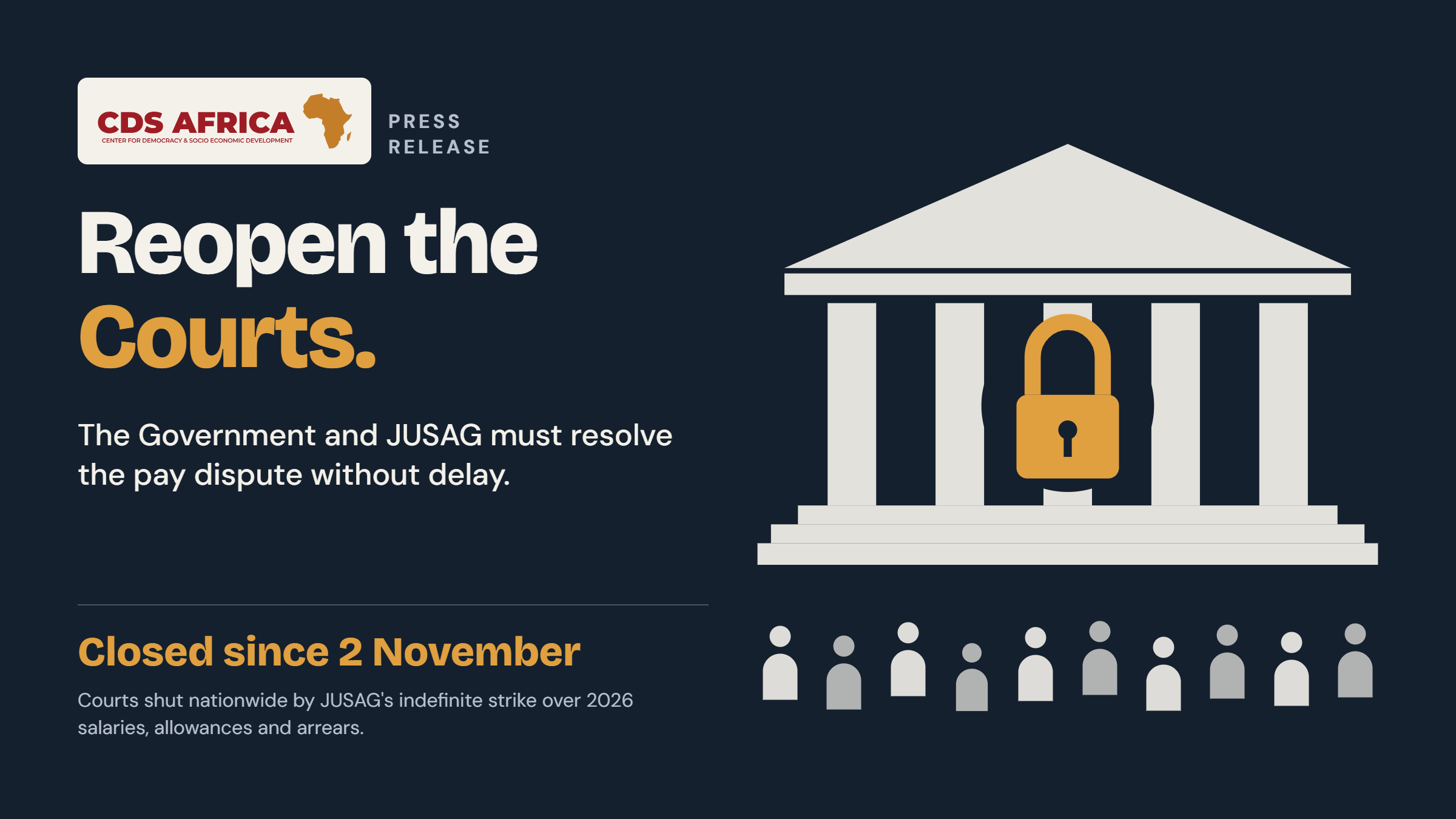
Reopen the Courts: The Government and JUSAG Must Resolve the Pay Dispute Without Delay.
5
Nov
0
Reopen the Courts: The Government and JUSAG Must Resolve the Pay Dispute Without Delay.
CDS Africa calls on the Government of Ghana and the Judicial Service Staff Association of Ghana (JUSAG) to resolve, without further delay, the salary dispute that has kept the nation’s courts closed since Monday, 2 November 2026. A justice system unable to open its doors cannot protect the rights of anyone. As the Attorney General meets with the Minister for Finance today, we urge both parties to treat the reopening of the courts as a matter of constitutional urgency rather than routine wage negotiations.
Context
JUSAG announced an indefinite nationwide strike in response to the government’s failure to approve and implement the reviewed 2026 salaries and allowances recommended by the Judicial Council, along with arrears for January to October 2026. The Association relies on Article 149 of the 1992 Constitution and the Judicial Service (Terms and Conditions of Service) Regulations, 2025 (C.I. 141). The Judicial Secretary confirmed the strike and said management is in urgent talks with the government. On 4 November, the Attorney General and Minister for Justice, Dr. Dominic Ayine, met with the Association, affirmed the legitimacy of its concerns, and pledged to place them at the top of his agenda with the Minister for Finance, Dr. Cassiel Ato Forson.
Analysis
Article 125 of the Constitution provides that justice emanates from the people and is administered in their name by the Judiciary. When the courts are closed, this promise is suspended for every citizen. The resulting burden is not borne equally. Article 14 requires that a person who has been arrested be brought before a court within forty-eight hours and that a detained person be tried within a reasonable time. Article 19 guarantees every accused person a fair hearing within a reasonable time. Each day the courts remain closed places these guarantees under strain. Beyond the criminal docket, traders seeking to recover debts, widows pursuing estate matters, and mothers awaiting maintenance orders are also left waiting. Those living in poverty, who cannot afford alternatives to delay, are left waiting the longest.
The dispute also highlights a more fundamental weakness. The framers of the Constitution sought to protect the Judiciary from financial pressure. Article 127 guarantees its independence and charges its administrative expenses to the Consolidated Fund, while Article 149 entrusts the determination of Judicial Service remuneration to the Judicial Council, subject to the President’s approval. When a recommendation remains pending until staff withdraw their labor, this safeguard is not functioning as intended. Ghana needs a clear and timely approval process rather than a cycle of ultimatums.
We acknowledge the fiscal pressures facing the State as it prepares the 2027 Budget, due on 12 November, and the importance of ensuring fairness across the public service. However, fiscal discipline is best maintained through predictable processes, rather than by deferring obligations until institutions are unable to function. We commend the Attorney General for engaging directly with the Association. We also urge JUSAG to consider the rights of citizens who remain outside the locked gates.
Recommendations
- The Minister for Finance and the Office of the President should reach a decision this week on the Judicial Council’s 2026 recommendations and publish a clear schedule for the payment of any approved salaries and arrears.
- The Fair Wages and Salaries Commission and the Ministry of Labor should immediately convene structured negotiations with JUSAG, with the Judicial Service management at the table.
- Pending agreement, JUSAG should restore a minimum essential service for urgent matters, including bail applications, remand hearings, habeas corpus proceedings, and cases involving children and domestic violence.
- Once work resumes, the Chief Justice and the Judicial Council should publish a plan to address the backlog caused by the strike, prioritizing individuals in detention.
- Parliament, through its Committee on Constitutional, Legal and Parliamentary Affairs, should review the process for approving the conditions of service for the Judicial Service to ensure that future reviews are completed promptly.
CDS Africa maintains that an independent and accessible judiciary is the cornerstone of constitutional democracy. We will closely monitor the discussions and assess the impact of the strike on detained persons and court users.
Categorised in: Articles, CDSAfrica, Research Report