
info@cdsafrica.org

CDS AFRICA WELCOMES PASSPORT CANCELLATIONS, CALLS FOR FULL DISCLOSURE AND PARLIAMENTARY INQUIRY
9
Nov
0
CDS AFRICA WELCOMES PASSPORT CANCELLATIONS, CALLS FOR FULL DISCLOSURE AND PARLIAMENTARY INQUIRY
CDS Africa notes the MoFA statement of Sunday 8th November 2026 which announced the cancellation of 10 unlawfully issued service passports, the interdiction of two officials and the referral of the matter to the Ghana Police Service. More needs to be done. The Ministry of Foreign Affairs (MoFA) was silent for a full month after receiving the first petition and the evidence shows the abuse continued right into this year. Whilst the MoFA has so far reported no confirmed evidence of the sale of diplomatic passports, the original allegations did specifically refer to the sale of such passports and no detailed findings have been made public. There is currently evidence of service passport irregularities but no evidence of diplomatic passport irregularities has been established or released. CDS Africa therefore calls on the MoFA’s investigative committee to publish its full report, for the Minister to appear before the Foreign Affairs Committee of Parliament. The Ghanaian passport is the passport of the Republic and citizens have a right to know why it was sold.
Background
The Ministry received the petition on 8 October and established an investigative committee on 13 October. On 3 November the Ranking Member of the Foreign Affairs Committee, Hon. Samuel Abu Jinapor, raised the issue in Parliament that diplomatic passports were being sold. He refused to withdraw the allegation without evidence and the Speaker ordered him out of the Chamber at that point, with the Minority following him out of the Chamber. On 6 November the Majority Leader, Hon. James Agalga, confirmed that the head of the Passport Office had been interdicted.
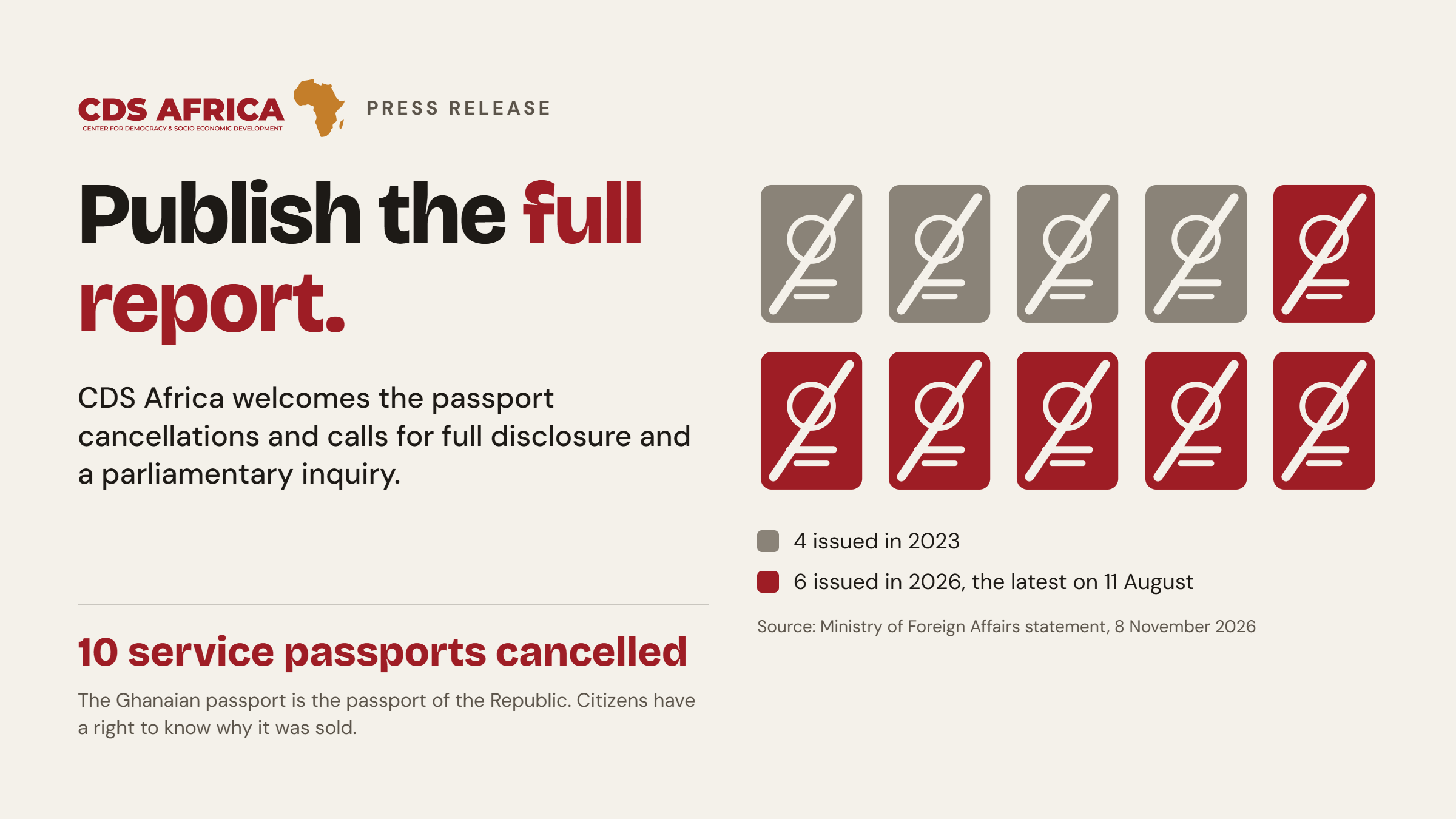
The Ministry’s statement is that 10 service passports were issued to people who didn’t qualify, allegedly via payment to a syndicate within the passport administration. Four were issued in 2023 and six in 2026 (the latest on 11 August). The officials named are the Acting Director of Passports (who heads the Passport Office), an Administrative Assistant in the Service Passports Unit and a former Director of Passports (who previously headed passport operations). All three are under investigation. The Ministry says there is no evidence of the sale of diplomatic passports.
Our assessment
The Ministry’s approach to this issue gives rise to three concerns.
First of all, timeliness. A whole month elapsed between the first petition and any public comment at all. The Majority Leader rather than the Ministry was the one to reveal the interdiction of the Head of the Passport Office. That’s a very serious matter and you just don’t go silent on it.
Secondly, honesty. The Ministry say the scheme predates the current administration, but six of the ten passports were issued in 2026 (i.e. after the reforms they cite). You can’t just point to one period as being to blame for the lack of controls.
Thirdly, the tone. A disclosure of wrongdoing shouldn’t be a record of achievement in any way. The fee reductions are absolutely fine, just not the point.
Art 35(8) of the Constitution places an obligation on the State to eliminate corrupt practices and the Right to Information Act 2019 (Act 989) gives the citizen that right. A summary of the preliminary findings does not satisfy that. The only way to achieve full transparency is through the full and unvarnished release of the investigative committee’s terms of reference, membership, evidence and findings. All relevant documents (including those on the criteria for eligibility and the criteria for issuing passports) must be made public. There must be open hearings before the Foreign Affairs Committee of Parliament which will be open to the public and the media. There must be clear timelines for the release of the information. That is the only way to rebuild public confidence and ensure that there is accountability at every stage.
Parliament has the constitutional means to complete the accountability process. Under Article 103 the committees of Parliament can investigate Ministries and have the powers of the High Court to summon witnesses and to require the production of documents. The Speaker was quite right to insist that the allegations be substantiated. The Speaker must refer the matter to the relevant committee where the evidence can be tested under oath.
The Minority have an equal obligation. The Ministry’s findings are with regard to service passports. The allegation in respect of diplomatic passports has not been established. The Minority have to put their evidence in because to keep it back only serves to increase the suspicion and politicize the allegation.
Our recommendations
CDS Africa calls on:
- The Minister for Foreign Affairs is to publish without delay the Terms of Reference, membership and full report of the Committee, and to brief the Foreign Affairs Committee in an open session.
- The MoFA will be publishing the eligibility criteria for diplomatic and service passports and will be commissioning an independent audit of the issue and recovery records from January 2025.
- The Ghana Police Service will conclude their investigations without delay and the Office of the Special Prosecutor will look into whether the conduct disclosed constitutes corruption of public officers.
- The Minority Leader and the Ranking Member on Foreign Affairs would be in a position to submit any evidence relating to diplomatic passports to the Foreign Affairs Committee, the Police or the Special Prosecutor.
- The Speaker will refer the matter to the Foreign Affairs Committee for inquiry under Article 103 and will fix a date for the report of the Committee.
Conclusion
Public confidence is built through firm and accountable action by institutions. Our concern is with the integrity of the national document and not with any party or individual. We will be monitoring the inquiry very closely and will be providing regular updates via press briefings and bulletins on our website and social media. CDS Africa will also be publishing a full assessment of the Ministry’s response following the inquiry and will be alerting our media partners as key developments emerge.
Categorised in: Newsletter, Politics, Press Release, Research Report